.png)
A destination elopement photographer's year might look like this: Patagonia in March, the Dolomites in June, the Pacific Northwest in September, Southeast Asia in January. Four continents. Four couples who found your portfolio and booked you a year out. Your calendar is full. Your Instagram is going to look unreal.
Your credit card statement already looks unreal, and not in a good way. Flights to South America: booked four months early to get a reasonable fare. Lodging in the Dolomites: the good places near the trailhead sell out, so you put down a deposit in February for a June shoot. Permit fees for the national park: due 90 days in advance. Gear rental for the helicopter elopement: deposit required at booking.
The couple's final payment? Due 30 days before the event — 11 months from now.
Nobody mentions this cash flow timing mismatch in the "how to become a destination elopement photographer" blog posts. Your costs are front-loaded. Your income is back-loaded. In between sits a gap that your personal savings or your credit card interest rate fills. That arrangement holds up until you have three destination bookings overlapping and the travel costs stack faster than the installment payments come in.
You can't post your way out of a cash flow mismatch. More Instagram content doesn't make money arrive faster. The actual fix lives in how you structure your payment terms, and how quickly the money hits your account once a client pays.
Payment milestones are the first piece. Instead of collecting a retainer and a final balance, break it into stages: a non-refundable retainer at booking to lock the date, a second installment at 90 days or when you start incurring travel costs, a third at 30 days before the event, and the final balance on delivery. Each milestone ties to a real moment in the project and brings cash in before you need to spend it. In Maroo, each due date in a payment schedule can follow the invoice date, land on the event date, use a smart date set before or after the event, or be a custom date.
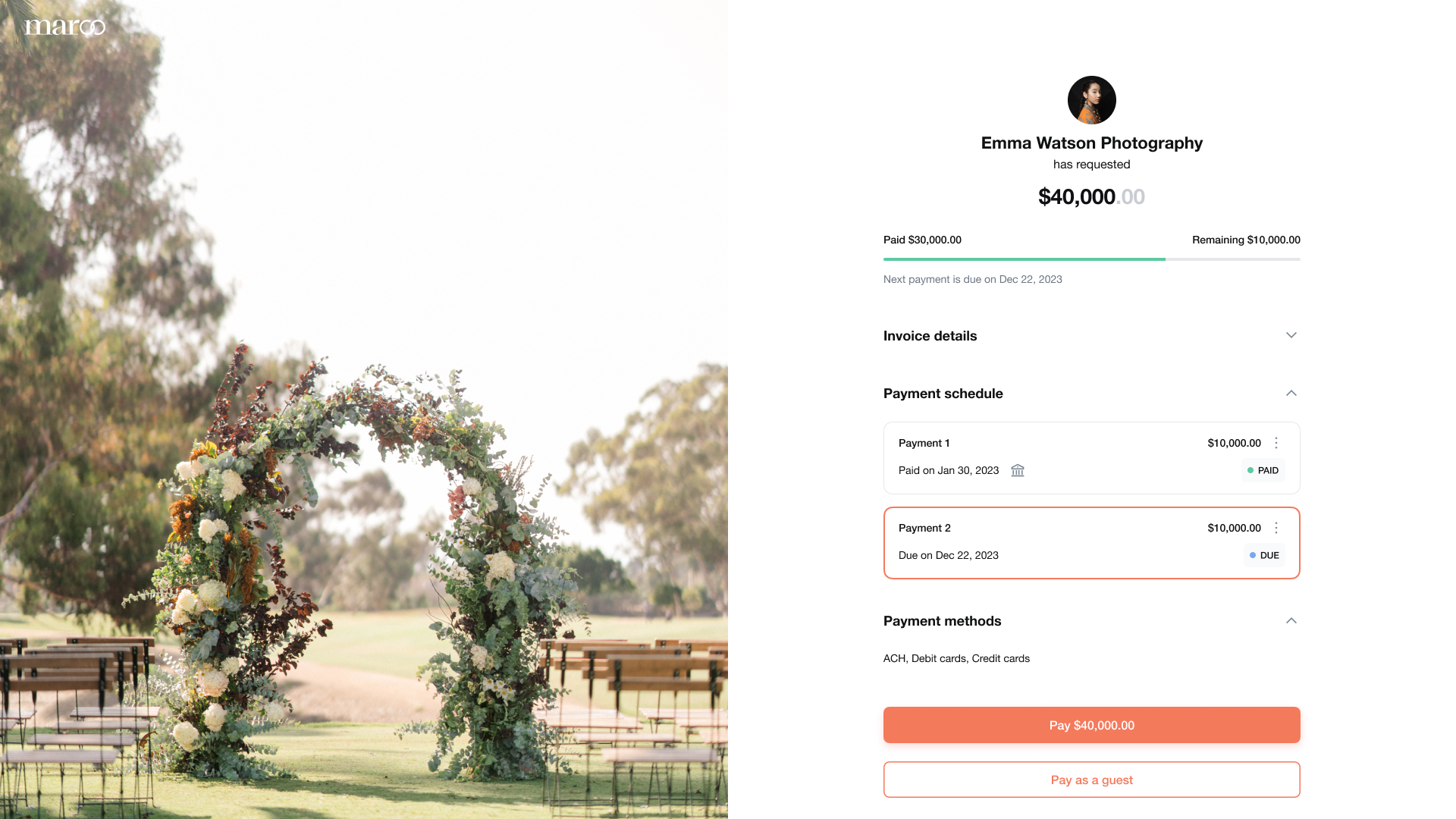
Automated invoicing with milestone reminders means you're not manually chasing payments while scouting locations and coordinating with a local guide across six time zones. The invoice goes out on schedule, the reminder fires if they miss it, and the payment lands without you having to play collections agent mid-trip.
The second piece is payout speed. If a couple pays on Monday and the money doesn't reach your bank until the following Monday, you're financing a week of float yourself. Check the payout options and timing available for your account, and allow for processing time before committing to travel costs.
For a Maroo invoice with more than one scheduled payment, Autopay applies to the payment schedule rather than an individual installment. Automatic collection is separate from recurring invoices, which generate new invoices on a repeating schedule. Watch the scheduled Autopay tutorial.
The other cash flow trap is letting travel costs blend into general pricing. If your elopement package is "$8,000 all-inclusive" and you're absorbing $2,500 in flights, lodging, and permits, you won't know your actual margin on that event until you've finished the work and tallied the receipts.
Itemize everything. Photography coverage as one line item. Travel as another. Lodging. Permits. Gear rental. When the couple sees exactly what they're paying for, there's no ambiguity — and when you review your year-end numbers, you can tell which destinations actually made you money versus which ones looked great on the grid but cost more than they brought in.
Creative businesses that sorted out their money systems tend to share one habit: they stopped treating pricing as a lump sum and started treating it as a transparent breakdown. Couples respond well to that honesty, and your accountant will have a much easier time at year-end. More importantly, you'll finally know whether Iceland in June was a sound business decision or just a really expensive vacation with a camera.