
A wedding photographer set up what he thought was a smart three-tier pricing system. Two thousand for the basic package. Three thousand for the mid-tier. Four thousand for the premium. The premium included everything: 12 hours of coverage, a second shooter, an album, parent books, and an engagement session.
After a couple of seasons, he ran the actual numbers. The second shooter cost him $500 per wedding. The album and parent books ran another $400 in production. The extra hours pushed his editing time up by a full day. When he subtracted all of it, his $4,000 package netted him less than his $3,000 one.
He'd been losing money on his most expensive offering for two years and had no idea.
This happens more than people admit. You look at what other photographers charge, pick numbers that feel right, and build packages around them. But "feeling right" isn't the same as running a cost-of-doing-business calculation.
According to a Fearless Photographers survey, the average U.S. wedding photographer charges just above $3,700 for eight hours. But that average hides enormous range. Full-time professionals typically price between $5,000 and $10,000. Beginners sit closer to $500 to $1,200. The number that matters isn't what others charge. It's what each wedding costs you to deliver.
Here's a rough breakdown for a mid-range photographer charging $5,000 per wedding: $400-600 for a second shooter, $200-400 for album production, $100-200 in travel costs, $50-100 in editing software per wedding, plus insurance, gear depreciation, and self-employment tax. Before paying yourself, you might be spending $1,500 to $2,000 per wedding just to fulfill the deliverables. And that doesn't count the 30-40 hours of editing, communication, and album design per event.
If you're shooting 25 weddings a year, your pricing needs to cover all of that and still leave you with a salary you can live on.
The fix is making every cost visible before you send the quote. Not after.
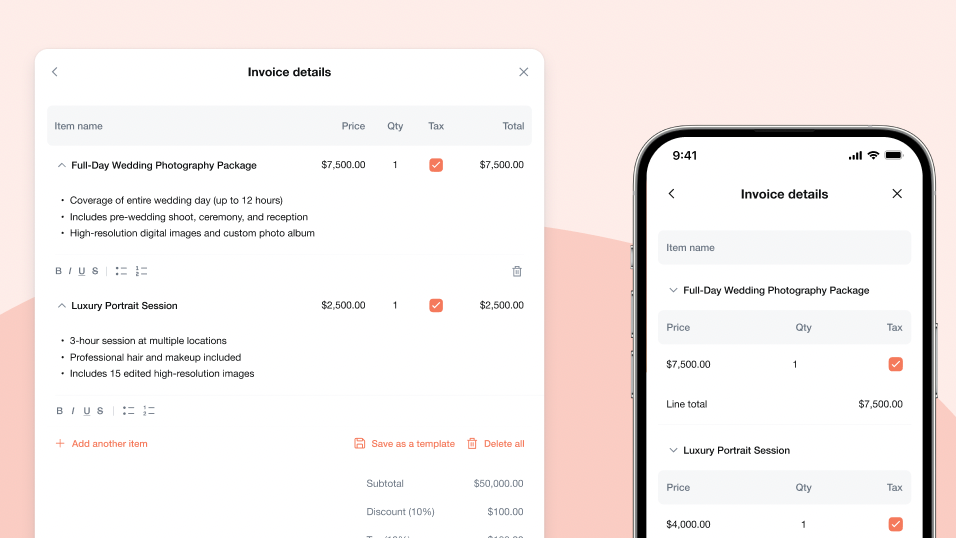
When you build proposals with itemized invoicing, every deliverable sits on its own line: 10 hours coverage, 1 second photographer, 500 edited images, 1 engagement session, 1 heirloom album. You can see exactly what you're committing to and what each line costs you to deliver. If your premium package includes an album that eats $400 in production and you've only built $200 of margin into it, the invoice shows you that before the client signs.
It's also worth revisiting your packages at least once a year. One photographer told me she restructured her pricing after realizing her inquiry volume was high but her booking rate was low. She wasn't pricing for her market. After adjusting, her bookings jumped within weeks.
The takeaway: don't build packages on vibes. Build them on math. Price every deliverable as a line item, calculate your true cost per package, and restructure before you book another wedding at a loss.